


Starting IVF is not just about walking in for treatment, but must begin with a comprehensive assessment so that the physician can plan treatment to suit each individual. If you are wondering why multiple blood tubes are drawn or why repeated ultrasounds are necessary, this article has answers from the Gift Fertility specialist team.

How Do Pre-IVF Tests Help Plan Treatment?
Testing before ovarian stimulation is not just for a general health check, but helps the physician see important information for both the female and male partners in order to plan treatment suitable for each couple, with results helping to evaluate:
- Which type of ovarian stimulation medication to use and what dosage
- How the ovaries are likely to respond to medication
- Whether to choose IVF or ICSI
- Whether there are factors that might interfere with implantation and should be treated first
Tests for Women Before IVF
1. Hormone Tests (Hormonal Profile)
Some hormones, such as FSH, LH and Oestradiol (E2), are usually tested on days 2–3 of the menstrual cycle to assess ovarian function at the beginning. AMH can be tested without waiting for any particular phase of the menstrual cycle.
- AMH (Anti-Müllerian Hormone): Used to assess ovarian reserve and help predict whether the ovaries may respond strongly or weakly to stimulation medication, but cannot be used to indicate egg quality or the chance of pregnancy.
- FSH, LH and Oestradiol (E2): Tested to assess ovarian function and plan ovarian stimulation.
- TSH (Thyroid) & Prolactin: Used to check for thyroid and prolactin abnormalities, which may be related to menstrual cycles, ovulation and treatment planning.
Hormone levels must be interpreted alongside age, ultrasound findings, medical history and laboratory reference ranges; conclusions should not be drawn from any single figure alone, particularly for TSH in the 2.5–4.0 mIU/L range, which does not mean that everyone requires treatment before IVF.
2. Transvaginal Ultrasound
The physician will perform an ultrasound to examine the uterus and ovaries while counting the antral follicle count (AFC), which is evaluated alongside AMH to help predict how the ovaries will respond to stimulation medication. However, both test results cannot be used to directly indicate embryo quality or pregnancy chances, with the physician considering the following key information:
- Antral follicle count (AFC): Used to evaluate ovarian reserve together with AMH.
- Uterine structure: Checks for abnormalities such as polyps or fibroids that may relate to implantation.
- Ovaries: Checks for cysts, chocolate cysts or other abnormalities that might affect the treatment plan.
The physician will perform an ultrasound to examine the uterus and ovaries while counting the antral follicle count (AFC), which is evaluated alongside AMH to help predict how the ovaries will respond to stimulation medication. However, both test results cannot be used to directly indicate embryo quality or pregnancy chances, with the physician considering the following key information:
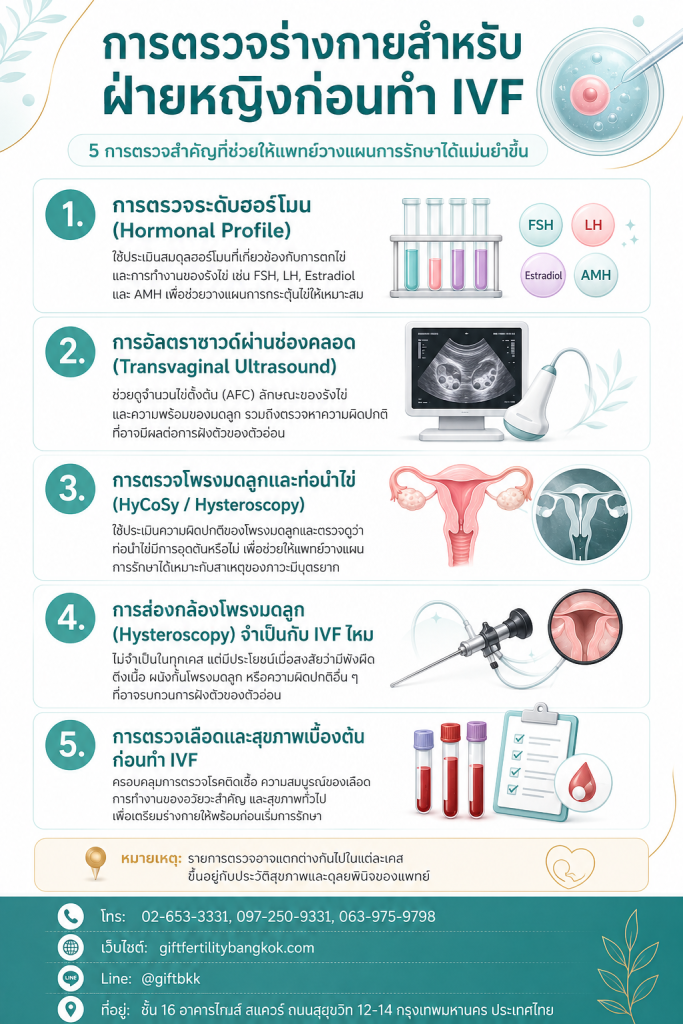
3. Assessment of the Uterine Cavity and Fallopian Tubes (HyCoSy / Hysteroscopy)
Not everyone undergoing IVF needs additional fallopian tube testing. The physician will consider medical history and ultrasound findings, particularly when tubal blockage or fluid accumulation is suspected.
Although IVF does not rely on fallopian tubes for fertilization, if hydrosalpinx is present, fluid may flow into the uterine cavity and affect embryo implantation. In some cases, the physician may therefore recommend treating this condition before embryo transfer.
4. Is Hysteroscopy Necessary Before IVF?
The physician may consider hysteroscopy in the following cases:
- Ultrasound detects or suspects abnormalities within the uterine cavity.
- History of recurrent miscarriage or prior uterine surgery.
- Previous unsuccessful embryo transfers, requiring investigation for additional factors according to indications.
However, hysteroscopy is not necessary for every patient undergoing IVF. If ultrasound results are normal and there are no additional indications, physicians generally do not recommend testing with this method prior to IVF.
5. Blood Tests and General Health Checks Before IVF
| Test Item | What it assesses |
| Complete Blood Count (CBC) | Checks for anaemia, preliminary infections and platelet levels before starting treatment. |
| Liver Function Test | Assesses liver health prior to medication use and procedures. |
| Kidney Function Test | Checks kidney function to assist in medication planning and additional testing if necessary. |
| HIV, Hepatitis B and C, and Syphilis | Screens for infectious diseases that may affect treatment, pregnancy and laboratory care. |
| Blood Group and Rh | Checks blood type and Rh factor to plan care during pregnancy. |
| Rubella IgG | Tests immunity to rubella; if immunity is absent, the physician may recommend vaccination before pregnancy. |
Screening for infectious diseases and immunity before pregnancy helps the physician plan treatment and reduce risks for both the patient and the baby, with individuals lacking rubella immunity receiving vaccination prior to pregnancy per medical advice. Actual test items may vary depending on health history, previous test results and each clinic’s guidelines; they do not necessarily need to be identical for every case.
Tests for Men Before IVF
Pre-IVF evaluation should assess both the female and male partners concurrently because male-factor elements affect the choice of fertilization method and treatment planning. The physician will review health and fertility history alongside semen analysis to examine volume, concentration, motility and morphology of sperm. If initial test results or history indicate indications, further testing such as sperm DNA fragmentation testing may be considered to help select treatment approaches better suited to each couple.
Understanding Semen Analysis Results
Semen analysis evaluates semen volume, sperm count, motility and morphology. WHO reference values serve only as preliminary baseline figures; to conclude whether infertility exists, the physician must interpret all values together with both partners’ health histories.
| Parameter | WHO Reference Value | If Lower Than |
| Semen volume | At least 1.4 mL | May result from incomplete sample collection, abstinence duration, or certain abnormalities; the physician may advise repeat testing. |
| Sperm concentration | At least 16 million/mL | Indicates a relatively low sperm concentration per millilitre, which must be evaluated alongside total sperm count and motility. |
| Motility | Total motility at least 42% | Reduced sperm movement, which may affect the likelihood of sperm reaching and fertilizing the egg. |
| Normal morphology | At least 4% | If normal morphology is low, the physician interprets it alongside count and motility; conclusions should not be made from this value alone. |
Results below the reference values do not mean IVF cannot be performed, nor do they mean everyone must immediately undergo ICSI. The physician will review overall semen findings together with the female partner’s factors, treatment history and previous fertilization outcomes to choose whether IVF or ICSI is more suitable for each couple, with ICSI typically considered when clear male factors are found or past fertilization problems have occurred.
The male evaluation involves more than standard semen analysis; the physician considers overall test results to choose a treatment method suited to each couple.
- Semen analysis: Evaluates sperm count, motility and morphology. If abnormalities are found, the physician may consider ICSI to assist fertilization.
- Sperm DNA Fragmentation Index (DFI): May be considered in certain cases to assess genetic material damage in sperm, which could relate to embryo development or recurrent miscarriage even when routine semen analysis results are normal.
Which Test Results Will Cause the Physician to Adjust Your IVF Plan
| Test Finding | Physician Recommendation |
| Very low AMH | Mini-IVF / Natural Cycle IVF / Multi-cycle egg accumulation |
| High FSH + low AMH | Adjust stimulation protocol to shorter duration and higher intensity |
| TSH above 2.5 | Treat thyroid for 1–3 months before starting |
| Hydrosalpinx | Surgically treat fallopian tubes before IVF |
| Polyps/Fibroids in uterine cavity | Hysteroscopic removal first |
| High DFI (>25%) | ICSI + consider TESE |
| Very low sperm count | ICSI instead of conventional IVF |
| All test results normal | Unexplained Infertility — IVF is the suitable next step |

When Should Pre-IVF Tests Be Done and What Schedule Is Required
Pre-IVF testing has a timeline related to the menstrual cycle, particularly hormone testing and ultrasound for the female partner, to provide the physician with suitable data for treatment planning.
Day 1 of the Menstrual Cycle
Count the day with full menstrual bleeding as day 1 of the cycle and notify the clinic to schedule testing during days 2–3.
Days 2–3 of the Menstrual Cycle
Test results during this period help evaluate ovarian function, antral follicle count and readiness prior to ovarian stimulation, with the physician scheduling key tests including:
- FSH, LH and E2 hormone tests
- Prolactin and thyroid hormone tests
- Basic blood tests such as CBC, liver and kidney function tests, and infectious disease screening
- Ultrasound to count antral follicles (AFC) along with examination of the uterus and ovaries
AMH Can Be Tested on Any Day
AMH testing does not require waiting for days 2–3 of the cycle; it can be tested on any day to evaluate ovarian reserve alongside ultrasound and other hormone results.
Tests for the Male Partner
The male partner can undergo semen analysis during the same timeframe, abstaining from ejaculation for approximately 2–5 days prior to testing in order to evaluate sperm count, motility and morphology.
In some cases, the physician may consider additional sperm DNA fragmentation testing based on history and preliminary test results.
After All Tests Are Complete
Most test results take approximately 3–7 days. Once complete information is available, the physician will schedule an appointment to explain the results and plan treatment suitable for each couple, such as choosing IVF or ICSI as well as the type and dosage of stimulation medication.
Pre-IVF Testing for Women Aged 35+ and 40+
| Age Group | Additional Tests and Evaluations | Rationale |
| Under 35 years | Basic assessments based on history and partner evaluations | Routine chromosome testing is generally unnecessary based on age alone |
| 35–39 years | Detailed evaluation of ovarian reserve and consultation on PGT-A for appropriate cases | As age increases, the chance of finding embryos with chromosomal abnormalities rises, but must be considered alongside embryo count and the chance of obtaining embryos for testing |
| 40 years and above | Evaluation of ovarian reserve and embryo acquisition chances, alongside individual consideration of PGT-A benefits and limitations | PGT-A may be beneficial for older patients with sufficient ovarian reserve, but does not guarantee an increased live birth success rate for everyone |
Note: Karyotyping is the chromosomal testing of both female and male partners to check for structural abnormalities such as balanced translocations. The physician may consider this test when there is a history of recurrent miscarriage, previous chromosomal abnormalities from pregnancy, or relevant family history. If either partner is found to be a carrier of structural abnormalities, the physician may discuss PGT-SR to select embryos prior to transfer.
Frequently Asked Questions (FAQ)
Can Test Results from Another Hospital Be Used?
They can provide a starting point, although some tests, such as AMH and ultrasound, may need to be repeated because results can change over time.
Do Test Results Expire?
AMH and FSH: Repeat testing is often advised when the results are more than six months to one year old.
Infection screening: Results may be accepted for around one year, depending on laboratory requirements.
Ultrasound: A new examination is recommended in the cycle before ovarian stimulation.
Do Both Partners Need to Attend on the Same Day?
No. They do not need appointments on the same day, but results from both partners should be available before the treatment-planning consultation.
Can a Couple Have Infertility Even When All Tests Are Normal?
Yes. This is known as unexplained infertility and is reported in approximately 15–30% of couples experiencing infertility. IVF is often considered as a possible next step.
Is Fasting Required Before Hormone Testing?
The recommended preparation is to avoid food and water for approximately eight hours before blood tests. If only AMH is being tested, water may be consumed normally.
Summary of Testing and Preparation Steps Before IVF
- Tests for female partner: On days 2–3 of the menstrual cycle, undergo hormone tests, basic blood work and ultrasound.
- Tests for male partner: Semen analysis and sperm DNA testing when indicated.
- Wait for results: Approximately 3–7 days, then schedule a physician consultation.
- Treatment planning: The physician evaluates results for both partners and selects a suitable approach.
- Preparation: Treat abnormalities that might affect treatment prior to ovarian stimulation.
Consult on a Treatment Plan Specifically Suited to You
Physical examinations before IVF are not just for “checking readiness,” but involve gathering crucial information to design a treatment plan that truly suits you—whether choosing the medication protocol, expected egg yield, or deciding between IVF and ICSI.
When test results are properly understood, treatment planning becomes clearer, reducing uncertainty and increasing success chances right from the start.
The reproductive medicine team at Gift Fertility is ready to help analyze your test results in detail and map out the most suitable treatment approach so that every step of family building has a clear direction and greater confidence.