Choosing between IVF and ICSI at the age of 40 is not simply a matter of which treatment is better. The two methods have different roles, and outcomes depend on factors such as egg quality, ovarian reserve, sperm quality and previous treatment.
From a fertility specialist’s perspective, those findings should guide the choice rather than general assumptions about either method. At this age, time is a critical factor, and every treatment cycle counts.

Which Is More Suitable at Age 40: IVF or ICSI?
For women aged 40, ICSI is typically recommended because egg quality declines and the outer shell thickens over time, directly affecting fertilization. By injecting a sperm directly into an egg, ICSI is intended to reduce the risk of fertilisation failure. Conventional IVF may still be suitable when other findings are favourable.
Although both treatments may be discussed when planning assisted reproduction, age can affect the number and quality of eggs available, fertilisation and the likelihood of treatment success. The decision therefore calls for more than a general comparison of the two procedures.
There is no single answer for every woman aged 40. The following sections explain the biological considerations and findings used to discuss treatment in practice.
Why Does Age 40 Change the IVF–ICSI Decision?
1. Changes to the Egg’s Outer Layer (Zona Pellucida)
The zona pellucida is the outer layer surrounding an egg. With increasing age, the zona pellucida may become thicker or harder, potentially making it more difficult for sperm to penetrate the egg.
In conventional IVF, sperm must reach and penetrate the egg without direct injection. ICSI places a selected sperm directly inside the egg, bypassing that stage of fertilisation. This mechanism is one reason ICSI may be considered at age 40.
2. Declining Egg Quality
Age affects more than the number of eggs available. Changes in egg quality can include:
- An increased likelihood of chromosomal abnormalities
- Problems with cell division
- A lower proportion of embryos developing with favourable characteristics
Even when fertilisation occurs, it does not necessarily lead to a successful pregnancy.
3. Risk of Fertilisation Failure
One concern during conventional IVF is that none of the eggs may fertilise. This risk may be greater at age 40 and could leave a treatment cycle without embryos. ICSI offers a more direct means of carrying out the fertilisation step and is considered to help reduce this uncertainty.
4. The Importance of Time
At 40, a failed cycle can significantly reduce your overall chances of success. That’s why choosing the right fertilization method from the start is so important.
How Does a Fertility Specialist Choose Between IVF and ICSI at 40?
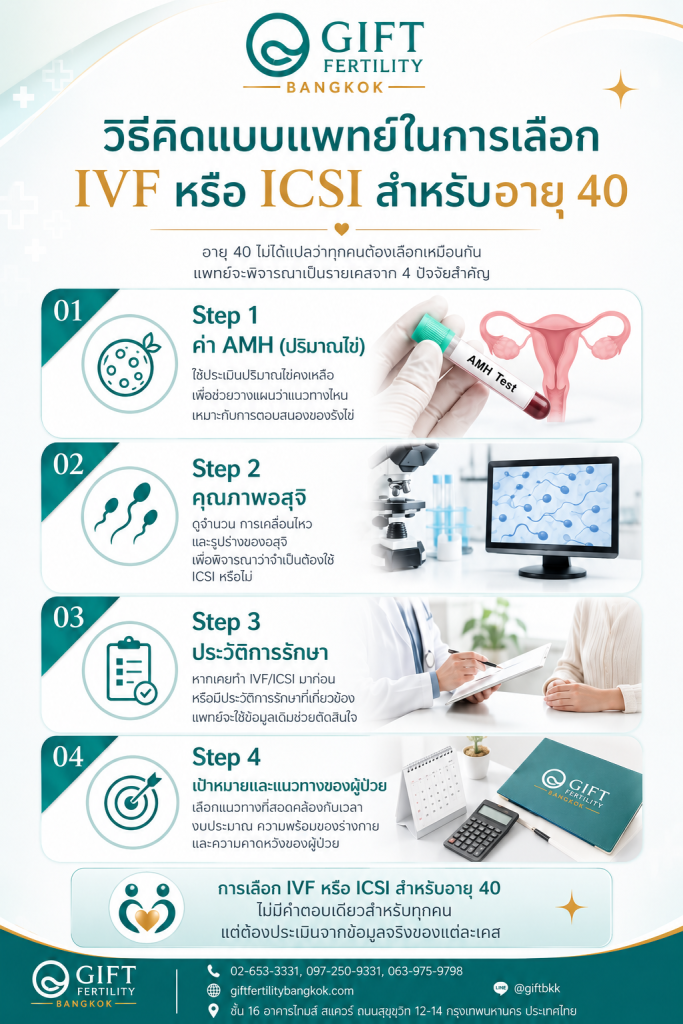
Choosing between IVF and ICSI for women aged 40 involves evaluating multiple factors together clinically rather than relying on a single indicator, ensuring the approach best suits each individual’s body through the following steps of consideration:
- Step 1 AMH and ovarian reserve
AMH provides information about the likely number of eggs available. When AMH is low, ICSI is often considered in an attempt to make the most of the available eggs. When the result is moderate or favourable, other factors can be reviewed before deciding. - Step 2 Sperm quality
Low sperm count, reduced motility or abnormal morphology may lead a fertility specialist to recommend ICSI. If semen results are within expected ranges, the choice can be assessed alongside the other findings. - Step 3 Previous treatment
If conventional IVF has previously resulted in zero fertilization, ICSI becomes the standard choice for the next cycle. For first-time treatments, the initial selection requires a comprehensive clinical review. - Step 4 Patient preferences and treatment goals
ICSI is typically chosen when patients prioritize minimizing the risk of fertilization failure. Conventional IVF remains an option when clinical profiles are favorable and a less intensive approach is preferred.
Choosing between IVF and ICSI for women aged 40 involves evaluating multiple factors together clinically rather than relying on a single indicator, ensuring the approach best suits each individual’s body through the following steps of consideration:
When Might Conventional IVF Still Be an Option at 40?
Conventional IVF may still be considered when:
- AMH is within a favourable range.
- Semen analysis is normal.
- There is no history of fertilisation failure.
- The patient prefers to minimise intervention where appropriate.
At this age, conventional IVF may carry a greater risk of fertilisation failure, making individual assessment important.
ICSI and PGT-A at Age 40
Fertilisation is only one concern at age 40. Embryo quality and chromosome number also affect treatment planning.
PGT-A is considered for the following purposes:
- Identifying embryos with the expected number of chromosomes
- Reducing the risk of miscarriage
- Improving the live-birth rate per embryo transfer
In selected circumstances, pairing ICSI with PGT-A is the standard approach at this age
IVF vs ICSI at Age 40: A Comparison
| Factor | Conventional IVF | ICSI |
| How fertilisation occurs | Sperm penetrates the egg without direct injection | A sperm is injected directly into the egg |
| Similarity to natural fertilisation | Closer to the natural fertilisation process | Directly assisted fertilisation |
| Cost | Generally lower | Generally higher |
| Risk of fertilisation failure | Higher | Lower |
| Control over the fertilisation step | Less direct control | More direct control |
| Suitability at age 40 | Viable only in selected cases with ideal baseline profiles | Suitable for many cases |
| Bypassing a potentially thickened zona pellucida | Does not bypass this stage | Bypasses this stage through direct injection |
| Potential to avoid losing a cycle to fertilisation failure | Lower | Higher |
Common Misunderstandings About IVF and ICSI at Age 40
- “ICSI is always better.”
ICSI may be suitable for many women in this age group, but it is not required in every case. - “IVF can no longer work at age 40.”
Conventional IVF remains an option for selected patients with favourable findings. - “The clinic can choose everything without the patient’s involvement.”
Understanding the differences can help patients take part in decisions and discuss the possible consequences of each approach.
Frequently Asked Questions About IVF and ICSI at Age 40
Does Everyone Aged 40 Need ICSI?
No. ICSI may be suitable for many women aged 40 because it allows direct sperm injection, but the choice depends on individual findings.
Can IVF Still Succeed at Age 40?
Yes. Conventional IVF remains an option for selected cases, although treatment risks may be higher.
Should Someone Switch to ICSI After an Unsuccessful IVF Cycle?
Yes, switching to ICSI is commonly recommended if a previous cycle suffered from fertilization issues, depending on the specific cause.
Choosing What Fits the Individual Situation
Neither IVF nor ICSI is the best method for every person aged 40. AMH, sperm quality, treatment history and patient preferences all contribute to the discussion.
ICSI may offer a practical advantage at the stage of sperm injection, but the most appropriate treatment still needs to be considered case by case.
Why an Early Treatment Assessment Matters
At age 40, timing can affect the treatment opportunities available. Reviewing the available information early may help the couple and their fertility specialist choose a method without unnecessary delays.
For anyone unsure which approach is appropriate at age 40, an initial fertility assessment can provide a basis for discussing the options and likely next steps.