


IVF treatment is not the only answer for everyone experiencing difficulty conceiving. Some couples may be advised to try intrauterine insemination (IUI) first. Others may benefit from addressing a health condition before starting IVF, while some should consider IVF without spending further time on less suitable options.
This guide helps you evaluate your situation through a decision framework from the medical team to see whether IVF is the most appropriate option for you.

Who Is IVF Suitable For? When to Consider Treatment or Wait
While IVF is a valuable treatment for specific medical indications, it is not always the first step for every couple experiencing difficulty conceiving. But what is equally important to know is that:
- Each person’s medical indications vary.
- IVF is not always superior to IUI in every case.
- Certain conditions must be addressed before IVF to achieve optimal results.
- Some cases suitable for IVF should undergo ICSI instead of conventional IVF.
Therefore, a more precise question than “Who is IVF suitable for?” is usually whether IVF is the most appropriate choice for your own case right now.
Which fertility conditions may be treated with IVF?
1. Both fallopian tubes are blocked or have been removed
This is the clearest indication because natural conception and IUI require functioning fallopian tubes for fertilisation. If both tubes are blocked or have been removed, IVF offers a way to achieve fertilisation without using the tubes, avoiding the need for tubal repair as the route to conception.
A further consideration is hydrosalpinx, in which fluid collects in a blocked fallopian tube. A fertility specialist may recommend removing or closing the affected tube before IVF because fluid entering the uterus can interfere with embryo implantation.
2. PCOS, with attention to the risk of OHSS
PCOS is a condition where IVF often yields good results because the ovaries contain multiple follicles, allowing multiple eggs to be retrieved per cycle. However, a stronger ovarian response can also raise the risk of ovarian hyperstimulation syndrome (OHSS), when the ovaries respond excessively to stimulation medication.
The physician manages this risk by using an antagonist stimulation protocol, adjusting medication doses, and considering a freeze-all approach instead of a fresh transfer in the same cycle. This is why PCOS requires an individually designed protocol rather than a standard formula applied to every case.
3. Endometriosis
IVF is suitable for stages 3–4 endometriosis or when IUI has been unsuccessful. For stages 1–2, where the fallopian tubes are open and sperm findings are normal, physicians typically try IUI first.
An additional issue to discuss is that an ovarian endometrioma can affect egg quality. The physician will evaluate whether to surgically remove it or proceed directly to egg collection, because cyst removal can sometimes damage surrounding ovarian tissue. There is no fixed answer, and it must be assessed on a case-by-case basis.
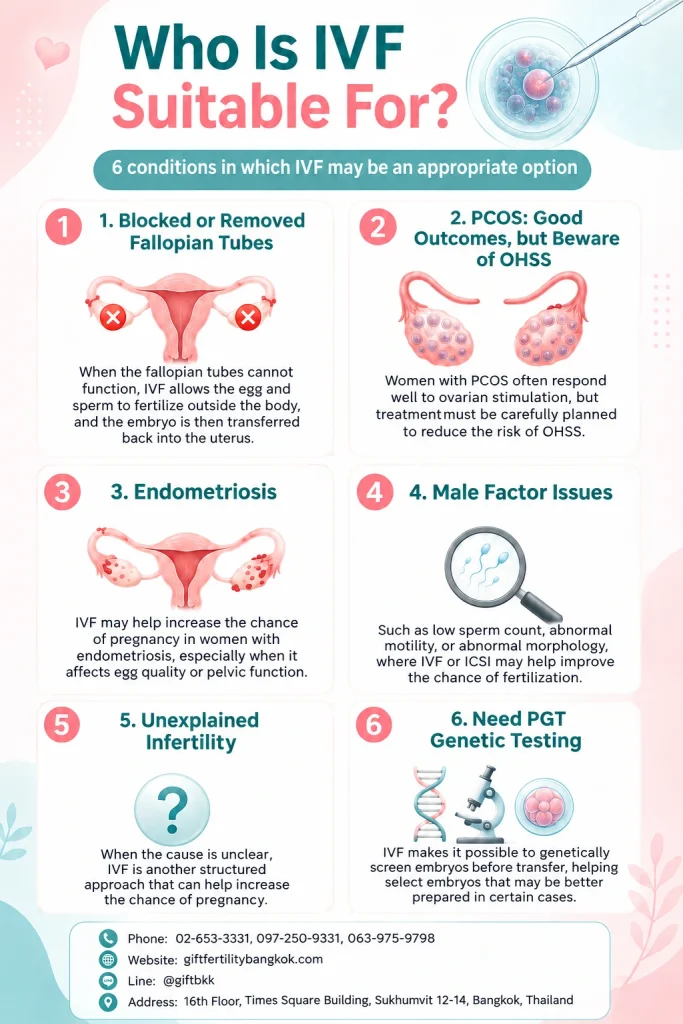
4. Male-factor infertility
| Male-Factor Finding | Recommended Approach |
| Mild to moderate abnormalities | Consider 3–4 cycles of IUI first |
| Severe oligospermia (very low count) | Proceed directly to IVF or ICSI |
| Azoospermia (no sperm in ejaculate) | ICSI combined with surgical sperm retrieval (e.g., TESE) |
| High DNA fragmentation (>25%) | ICSI, with possible consideration of TESE |
A very important point that is often overlooked is that if the main problem lies with the male partner, ICSI is usually more suitable than conventional IVF. This is because ICSI selects the best sperm and injects it directly into the egg, rather than letting them compete on their own.
5. Unexplained infertility
Unexplained infertility accounts for approximately 15–30% of couples experiencing difficulty conceiving. All test results are normal, but pregnancy has not occurred after trying for years. IVF helps because it allows physicians to see actual information that cannot be examined externally, such as whether eggs and sperm actually fertilise, how well embryos develop, and at which stage the problem occurs.
6. Embryo genetic testing is being considered
IVF is a prerequisite for all types of PGT.
| Type of PGT | When it may be considered |
| PGT-A | Older maternal age, recurrent pregnancy loss or concerns about chromosome number |
| PGT-M | A known single-gene condition or carrier status, such as certain forms of thalassaemia |
| PGT-SR | Structural chromosome rearrangements, including balanced translocations |
In the context of Thailand, thalassaemia is common in the population. Couples where both partners are carriers can undergo IVF + PGT-M to select embryos that have not inherited the abnormal gene before transfer.
When might IVF need to be postponed?
This is a section that almost no one writes about because most choose to talk only about the positive side, but complete information helps lead to better decisions.
Conditions to assess or manage before IVF
TSH above 2.5 mIU/L Unstable thyroid function directly affects implantation rates and miscarriage risks. Stabilising levels for 1–3 months beforehand frequently helps noticeably increase the chances of success.
Uterine polyps or fibroids Obstructions in the uterine cavity prevent embryos from implanting even if good-quality embryos are obtained. They should be removed via hysteroscopy before starting an IVF cycle.
High prolactin Elevated prolactin interferes with ovulation and implantation. Taking medication to adjust it beforehand usually takes a short time and yields good results.

Situations requiring detailed medical assessment
Very high BMI (>35) Significant excess weight affects response to stimulation medication, egg collection risks, and implantation rates. Some physicians recommend managing weight to a certain extent first, though this also depends on age and other factors, with no fixed answer.
Medical conditions that are not well controlled Examples include unstable heart disease, advanced kidney disease, or active autoimmune conditions. The physician will always assess the risks of stimulation medication and pregnancy on that condition first. This is not a refusal, but proper prioritisation of care.
When should a couple discuss stopping IVF?
This is the hardest question, and almost no one answers it directly. There is no universal number for “how many attempts mean you should stop,” but signs that physicians typically evaluate together with patients include: multiple rounds of good-quality embryo transfers failing repeatedly without an unexplained cause, ovarian reserve declining to the point where almost no eggs are retrieved per cycle, or physical and emotional well-being reaching a point where a pause or stopping may be a better option.
This decision has no right or wrong answer and should occur when complete information is received and one is ready to decide, rather than being told to stop without context.
Should you try IUI first or move directly to IVF?
The question most frequently asked but most often answered with “Consult a physician“.
When IUI may be considered first
- Mild to moderate semen abnormalities.
- At least one fallopian tube is open.
- Age under 35 and ovarian reserve remains satisfactory.
- Unexplained infertility with a relatively short period of trying.
- Stage 1–2 endometriosis with open tubes.
When IVF may be considered without repeated IUI
- Both fallopian tubes are blocked.
- Severe sperm abnormalities or azoospermia.
- Age 38 or older with low ovarian reserve; time is valuable, and trying multiple IUI cycles may not be worth the lost time.
- Stage 3–4 endometriosis.
- Plans for PGT genetic screening.
After how many unsuccessful IUI cycles should IVF be considered?
There is no universal number, but guidelines most physicians use as a principle:
| Maternal Age | Recommended IUI Cycles Before IVF |
| Under 35 | 3–4 cycles (if other factors are normal) |
| 35–37 | 2–3 cycles |
| 38 or older | 1–2 cycles, or consider IVF from the outset |
What is more important than numbers is what information was gained from each past IUI cycle and what that information reveals about the chances in the next cycle.
How do conventional IVF and ICSI fit into the decision?
The question that always follows “Who is IVF suitable for?” is whether conventional IVF or ICSI is better for your case.
Conventional IVF allows millions of sperm and eggs to mix in a culture dish to fertilise on their own, whereas ICSI selects a single sperm and injects it directly into the egg.
Physicians typically choose ICSI when:
- There are male-factor abnormalities, whether in count, motility, morphology, or DNA fragmentation.
- A previous IVF cycle resulted in fertilisation failure.
- The number of eggs retrieved is low, and you want to maximise the potential of every single egg.
- There has been a repeated history of poor embryo quality with an unknown cause.
In reality, the decision between IVF and ICSI must be evaluated for the couple together, rather than looking only at the female partner.
Other situations in which IVF may be considered
Recurrent miscarriage
For individuals who have experienced two or more miscarriages without a known cause, the problem sometimes lies in embryonic chromosomal abnormalities. IVF + PGT-A helps screen for embryos with normal chromosomes prior to transfer, which may help reduce the risk of future miscarriages in certain cases.
Egg freezing before someone is ready to have a child
In the context of Thailand, the law specifies that IVF treatment requires legally registered spouses. For women who do not yet have a partner but wish to preserve future opportunities, egg freezing is a feasible and most reasonable option.
| Situation | Recommended Option |
| Have a partner, ready for children | IVF |
| No partner, or not ready yet | Egg Freezing |
| Approaching 35 without a partner | Consider egg freezing as early as possible |
| Have a partner but not ready for children | Embryo Freezing |
Should IVF continue after one or two unsuccessful cycles?
For this scenario, the answer depends on what happened during each cycle rather than just counting the number of attempts. Things you should review back with your physician include:
- How did the ovaries respond to the stimulation medication?
- How many eggs were retrieved and how many fertilised?
- How well did the embryos develop?
- Whether embryo transfers have already been attempted
- Whether the uterine lining/cavity was thoroughly evaluated
- Whether there are concurrent male factors involved
- Should the protocol be adjusted or additional technologies added?
Some people complete 1–2 cycles and see clear reasons to keep going, whereas others may reach a point where discussing other options, such as donor eggs, is appropriate. The important thing is that the decision should stem from data gathered from each cycle rather than just the feeling that you have tried long enough.
Self-assessment: when might a fertility consultation be useful?
Evaluate yourself using this checklist. If you answer yes to two or more items, consulting a physician for an IVF assessment is likely an appropriate next step.
- You have tried to conceive for at least 12 months, or six months if you are 35 or older, without pregnancy.
- Testing has identified a blocked or damaged fallopian tube.
- Semen analysis shows severe abnormalities.
- Two or three IUI cycles or more have not resulted in pregnancy.